While such exponential growth proves our platform’s success to handle, anyone in the software engineering industry knows the complexities of scaling a system to meet surging demand. Achieving this requires building systems that are scalable, resilient, and high-performing, which demands relentless focus across various workstreams. One of the most critical areas that contributes to this success is infrastructure — the very backbone of our platform.
This article shares our journey of transitioning from a non-Kubernetes setup to a Kubernetes-based infrastructure. We’ll walk you through the challenges we faced, the trade-offs we made, and the solutions we ultimately implemented. Whether you’re an engineering leader, a systems architect, an infrastructure engineer, a DevOps engineer, or simply curious about modern infrastructure practices, we hope you find this story both insightful and inspiring. Get an inside look at the process and discover how you can leverage our learnings for your own tech transformation!
The On-Premise Infrastructure: Context and Challenges
While cloud providers have and keep making progress in improving compliance, security, and accessibility, financial services in many parts of the MENA region still face strict regulatory requirements. These often mandate that sensitive financial data be stored within the country’s borders, making on-premise infrastructure a necessity for organizations like Thndr.
At Thndr, a significant portion of our infrastructure remains on-premises to meet these regulatory demands. While this setup was sufficient during the early days, the rapid growth in user activity and transaction volume highlighted critical limitations. Upgrading our legacy on-prem infrastructure quickly became a top priority.
Our setup relied on a simple group of virtual machines (VMs), which introduced numerous challenges:
- Limited development and CI/CD capabilities:
– Applications were deployed as single processes without industry-standard development practices or robust CI/CD pipelines.
– Engineers worked on manual and error-prone deployment processes, an approach associated with risks, such as deploying outdated packages.
- Lack of automated testing:
– There were no automated test cases to validate releases before deployment, increasing the likelihood of bugs making it to production.
– Occasionally, deployments occurred during active market hours, compounding the risk of disruptions.
- Scaling Challenges:
– During periods of peak demand, the only option was to manually increase machine resources, a risky and reactive approach that could put platform stability on the line.
– The lack of instance scaling made it impossible to dynamically provision additional instances to handle traffic spikes.
- Operational Inefficiencies:
– Routine maintenance tasks like upgrading machines, installing updates and security patches, or clearing logs to free up disk space, had to be performed manually.
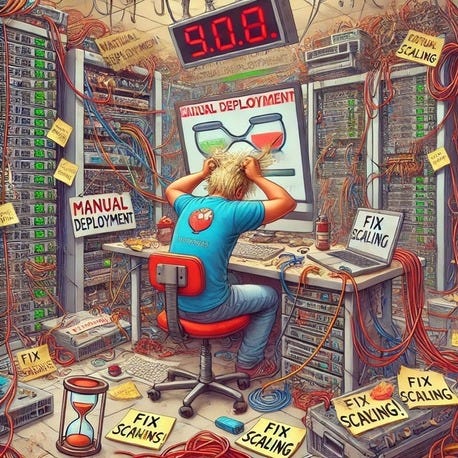
This image was generated using DALL-E
Discovery
The previously mentioned issues highlighted the pressing need for a scalable, automated, and resilient infrastructure, laying the groundwork for the pivotal decision to transition to a Kubernetes-based solution.
Why Kubernetes?
Kubernetes is our usual go-to choice for deploying and managing containerized applications since it supports flexible, scalable, reliable, and efficient environments. It makes nearly every aspect of management and deployment easier thanks to features like:
- Automated rollouts and rollbacks
- Service discovery
- Load balancing
- Storage orchestration
- Self-healing
When choosing a suitable Kubernetes cluster with limitations such as unavailable cloud solutions, you must work with a group of on-premises machines to create a semi-managed or unmanaged solution. To build Kubernetes on on-premises machines, there are several options available, including k3s, kubeadm, and EKS Anywhere.
Choosing the Right Kubernetes Solution: Balancing Constraints and Expertise
When setting up a Kubernetes cluster in your system, the chosen approach, tools, and version are determined by your constraints, areas of expertise, and existing toolset. At Thndr, we opted for k3s after extensive research and experimentation. K3s proved to be the optimal solution for Thndr. It required only a few on-premises machines with a lightweight Kubernetes version
The Way to K3s
What is K3s?
K3s is developed by the Rancher team, and it is a CNCF Sandbox Project. K3s represents a streamlined, simple-to-install, deploy, and oversee iteration of standard Kubernetes (K8s). K3s is an authorized Kubernetes distribution. While K3s is an enhanced variant of Kubernetes (the original version), its fundamental operation remains unaltered.
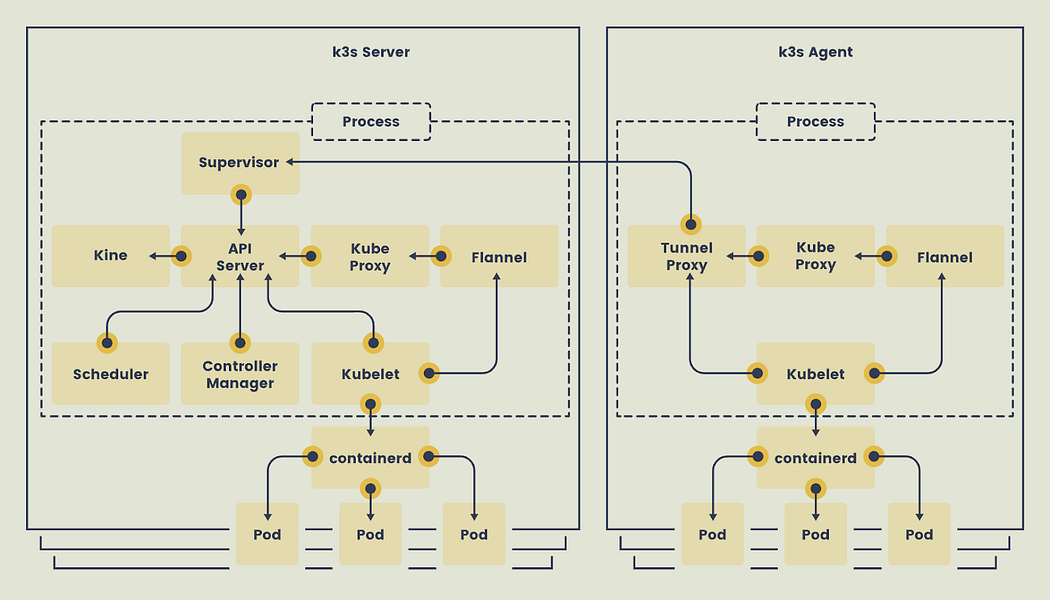
Reference: How k3s works
Why K3s?
- Even though the team had limited experience with setting up and configuring k3s, we didn’t encounter significant difficulties deploying k3s in our development and production environments.
- Rancher reduced the complexity of K3s by removing over 3 billion lines of code from the Kubernetes source. They trimmed down non-CSI storage options, experimental features, and outdated components that were not crucial for fully implementing the Kubernetes API.
- The single binary file is less than 100MB in size, enhancing speed and reducing resource consumption compared to K8s. Unlike Kubernetes, the master, nodes, and workers do not need to run in multiple instances to boost efficiency.
- The memory footprint is reduced primarily by running many components inside of a single process. This eliminates significant overhead that would otherwise be duplicated for each component.
- Certified Kubernetes distribution: Well supported and maintained, expected to remain as such for the foreseeable future.
- Easier and faster installation and deployment: K3s take seconds to minutes to install and run.
K3s’s Architecture
- A server node: Is defined as a host running the k3s server command, with control-plane and datastore components managed by K3s.
- An agent node: is defined as a host running the k3s agent command without any datastore or control-plane components.
- Both servers and agents run the kubelet, container runtime, and CNI. See the Advanced Options documentation for more information on running agentless servers.
- High-Availability: For environments where uptime of the Kubernetes control plane is critical, you can run K3s in an HA configuration. An HA K3s cluster comprises:
- Embedded DB: An embedded etcd datastore is stored inside each server node.
- External DB: An external datastore (such as etcd, MariaDB, etc.) is placed outside the cluster in a centralized place.
Install k3s
In that section, we will focus on the core components we have, starting from how we created the k3s and ending with how we receive the traffic.
Ansible
We rely on Ansible for configuration management to set up k3s, with special thanks to Vincent RABAH, who created the Ansible file structure for k3s setup. He is the author of many other valuable resources, so we encourage you to follow his work. Before proceeding, we recommend familiarizing yourself with the core components of Ansible through this link.
- What is Ansible? Ansible is an open-source automation tool for configuration management, application deployment, and task automation. using simple YAML playbooks to define tasks, making infrastructure management more efficient.
- Setting Up k3s: When installing k3s, you’ll have a group of machines. You can easily designate which machines act as masters and which as agents by configuring the inventory.yml file.
- Default Database Setup: By default, K3s uses an embedded DB. If you prefer using an external database, this can be done by adding the “-datastore-endpoint” as an extra argument and setting the “use_external_database” flag to true in the inventory.yml file.
- Upgrading k3s: To upgrade k3s at any time, simply update the “k3s_version” in the inventory.yml file with the desired version and run the provided playbook to upgrade all nodes in the cluster.
- Kubeconfig: After successful bringup, the kubeconfig of the cluster is copied to the control node and merged with ~/.kube/config under the “k3s-ansible” context.
- kubectl: Start with installing kubectl, you can confirm access to your Kubernetes cluster with the following: “kubectl config use-context k3s-ansible” and then “kubectl get nodes”
Supporting LoadBalancer Services in On-Prem Kubernetes Setups
On-premises Kubernetes environments lack the cloud-native support for LoadBalancer-type services found in platforms like AWS or GCP. Tools like Cilium, MetalLB, and ServiceLB fill this gap, each with a different approach.
- ServiceLB: Built into K3s, ServiceLB exposes services via node IPs. It’s simple but lacks true load-balanced Virtual IP (VIP) support, limiting flexibility for complex setups.
- MetalLB: Designed for bare-metal clusters, MetalLB uses either:
- L2 Mode: Broadcasts the LoadBalancer IP over the local subnet, offering simplicity but slower failover.
- BGP Mode: Advertises LoadBalancer IPs as routes to the network, enabling dynamic routing and scalability but requiring more configuration.
- Cilium: An eBPF-based tool focused on networking and security. It provides high-performance load balancing and direct kernel-level routing, though it may be overkill for simple setups.
Each tool offers unique trade-offs. ServiceLB is suited for basic needs, MetalLB balances simplicity and flexibility, and Cilium delivers advanced performance for modern networks.
Managing Storage in On-Prem Kubernetes with CSI Solutions
Kubernetes, originally designed for stateless applications, now supports StatefulSets to manage stateful workloads with persistent volumes. On cloud platforms, storage is dynamically managed using drivers like AWS EBS, GCE Persistent Disk, or EFS CSI Driver, enabling seamless scaling and reliability. However, in on-prem environments, storage management is more complex due to the lack of native, scalable storage options.
Container Storage Interface (CSI) solutions address this gap by enabling dynamic provisioning, replication, and failover for persistent volumes in on-prem Kubernetes clusters. Key CSI tools include:
- Longhorn: Provides lightweight containerized storage by replicating data synchronously across nodes for high availability. It ensures resilience by automatically switching workloads to healthy replicas during node or disk failures.
- Rook: Integrates with distributed storage systems like Ceph, offering advanced features like object, block, and file storage. It is ideal for clusters requiring flexible storage types and scalability.
- OpenEBS: Focuses on per-application storage, allowing developers to create lightweight volumes with specific requirements. It’s suitable for workloads needing fine-grained control over storage.
Each CSI solution varies in complexity and capabilities, from Longhorn’s simplicity to Rook’s versatility and OpenEBS’s application-centric design. These tools make on-prem storage management more reliable, scalable, and adaptable to diverse workload needs.
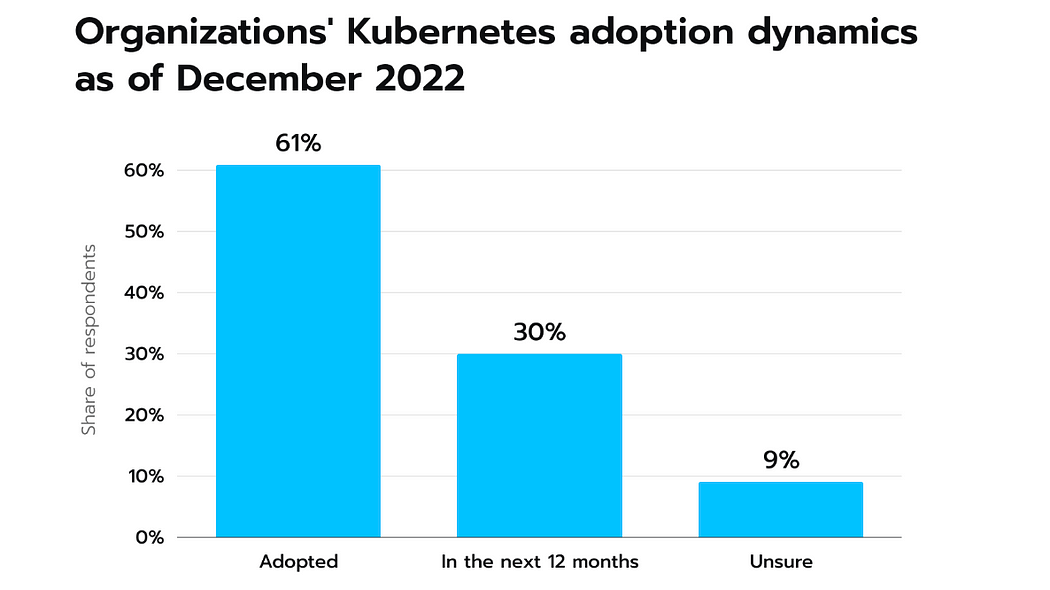
Reference: Kubernetes adoption levels
Unlocking New Advantages
- Modernizing Applications: Modernizing code involves restructuring and improving software to enhance performance, maintainability, and efficiency, ensuring it remains scalable and adaptable to evolving needs.
- Streamlined Continuous Integration (CI): A robust CI pipeline includes building container images, running test cases, tagging images with semantic versioning, performing security checks using tools like vulnerability scanners, and pushing validated images to a Container Registry (e.g., Docker Hub, GitLab, or JFrog).
- Automated Continuous Deployment (CD): GitOps tools streamline deployments by syncing Kubernetes configurations directly from a Git repository. These tools support automation, scheduling, and tracking changes, enabling teams to deploy updates reliably and efficiently.
- Resilient Service Mesh and Ingress Gateway: Adopting a service mesh simplifies microservice management by enabling features like rate limiting, circuit breaking, and advanced observability through request tracing and performance monitoring. By injecting a sidecar container into each service, the service mesh provides granular insights and control over inter-service communication.
- Unified Secrets Management: Managing sensitive data has improved significantly with tools that integrate with Kubernetes, ensuring secure and stable handling of credentials. Solutions like Consul, Azure Key Vault, and others offer centralized management, reducing the risks of exposure.
- Dynamic Auto Scaling: Kubernetes supports Horizontal Pod Autoscaler (HPA) for scaling applications based on CPU and memory usage. For additional flexibility, tools like event-driven scaling frameworks can scale workloads dynamically based on custom metrics or schedules, ensuring readiness for traffic spikes, such as those occurring during peak business hours.
- Comprehensive Monitoring and Observability: Monitoring tools enable automated tracking of CPU, memory, storage, latency, and errors. Alerts can be sent to collaboration platforms like Slack or escalation tools, helping teams address issues proactively. Popular tools include: Prometheus, Grafana, and log aggregation solutions.
- Proactive Incident Alerting: Incident alerting tools ensure timely responses by escalating alerts through predefined workflows. For instance, alerts may initially notify via messaging platforms and, if unacknowledged, escalate to on-call engineers and managers, ensuring issues are addressed promptly. Tools such as OpsGenie and Spike.sh support this process.
- Efficient Application Package Management: Managing configurations separately from application code ensures consistency across environments (e.g., staging vs. production). Tools like Helm enable templating and modular configuration management, simplifying the deployment of applications across clusters with environment-specific details.
Final Thoughts
The journey from a simple on-premise setup to a robust Kubernetes-based infrastructure has been one of the most impactful and prioritized projects at Thndr. While the transition presented its fair share of challenges, it has empowered us to scale effectively, deliver a more reliable and seamless experience for our users, and adhere to the regulations — all while positioning the platform for long-term growth.
As Thndr continues to expand in Egypt and the broader MENA region, we remain dedicated to evolving our infrastructure. Our goal is not just to meet the demands of today but to anticipate and prepare for the opportunities of tomorrow. This commitment is fueled by our mission to democratize investing, leveraging technology to provide a simple, barrier-free investing experience that is truly user-centric.
]]>Discover a financial revolution with Thndr App’s Investment Guide — crafted to simplify the staggering task of starting your investment journey. Triggered by user inquiries on social media, this feature resulted in an impressive ≈8 p.p increase in funded accounts to signups. Tailored for all investors, it enhances user experience, guiding decisions aligned with financial goals and risk tolerance. Join us to unveil the logic, explore diverse personalities, and gain insights from usability testing sessions.
The backstory of our game-changing Investment Guide
We all know it is overwhelming to start investing and find a good investment to start your journey with. So, why not help investors discover their investor personality and give them recommendations to improve their path to financial freedom?
Whether a beginner or an experienced investor, the Investment Guide feature helps you make informed decisions aligned with your financial goals and risk tolerance.
What was the trigger?
We received many CX inquiries and users were also asking on our social media platforms what to invest in. And, many of them weren’t familiar with the different investment products on Thndr.
Investment Guide card design: the entry point from the Explore page
A deep dive into tailoring our guide for maximized impact
We wanted to create a fun, short, and effective guide to have accurate outcomes. Hence, we focused on 4 main aspects that will determine an investor’s personality:
Objective: Determine a clear and specific investing goal.
Risk: Measure the tolerance for uncertain or adverse actions in a given situation.
Duration: Analyze the investing time frame.
Passiveness: Compare activity vs proactivity.
4 questions for each aspect mentioned above
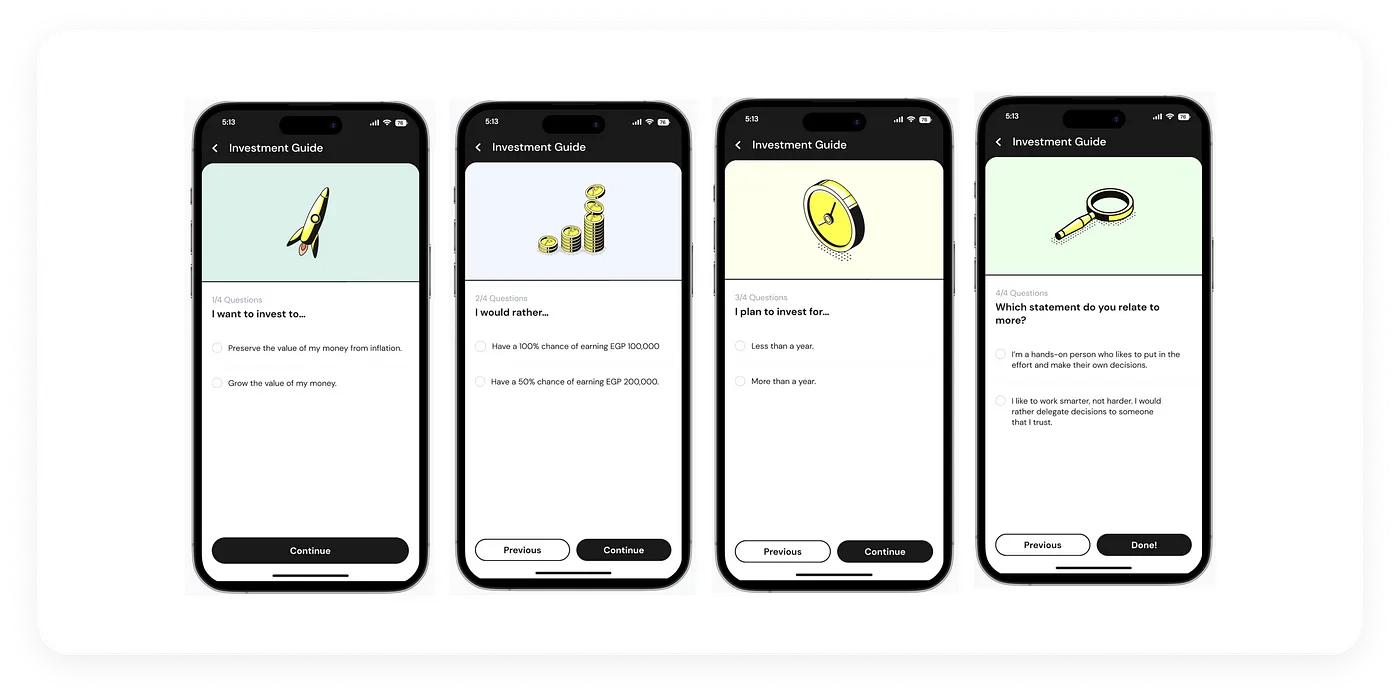
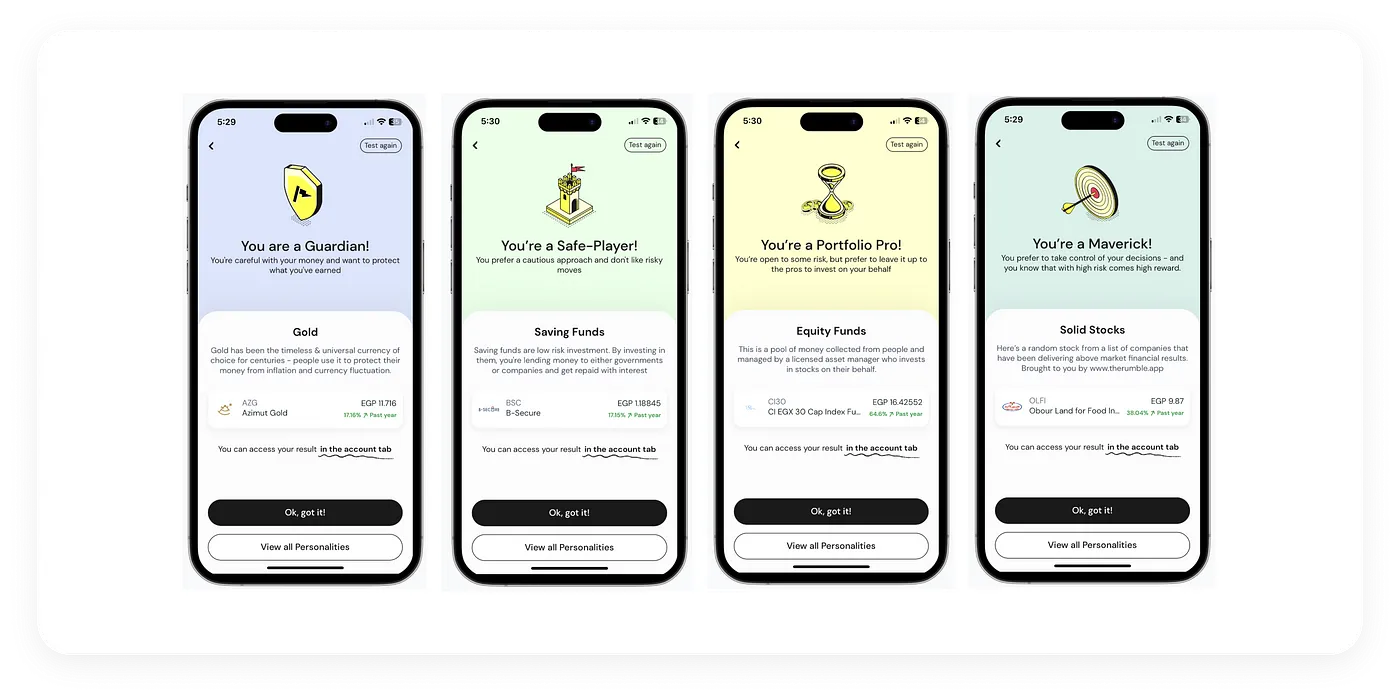
After pinpointing these 4 aspects we created 4 different personalities for all the possible results. Here they are:
Guardian: You know your money’s worth and want to guard your hard-earned treasure.
Maverick: You prefer to take control of your own decisions — and you know very well that with high risk comes an even higher reward.
Portfolio Pro: You’re open to some risk, but prefer to leave it up to the pros to invest on your behalf.
Safe-Player: Slow and steady wins the race; you’re not about taking chances.
4 personalities with their generated recommendations
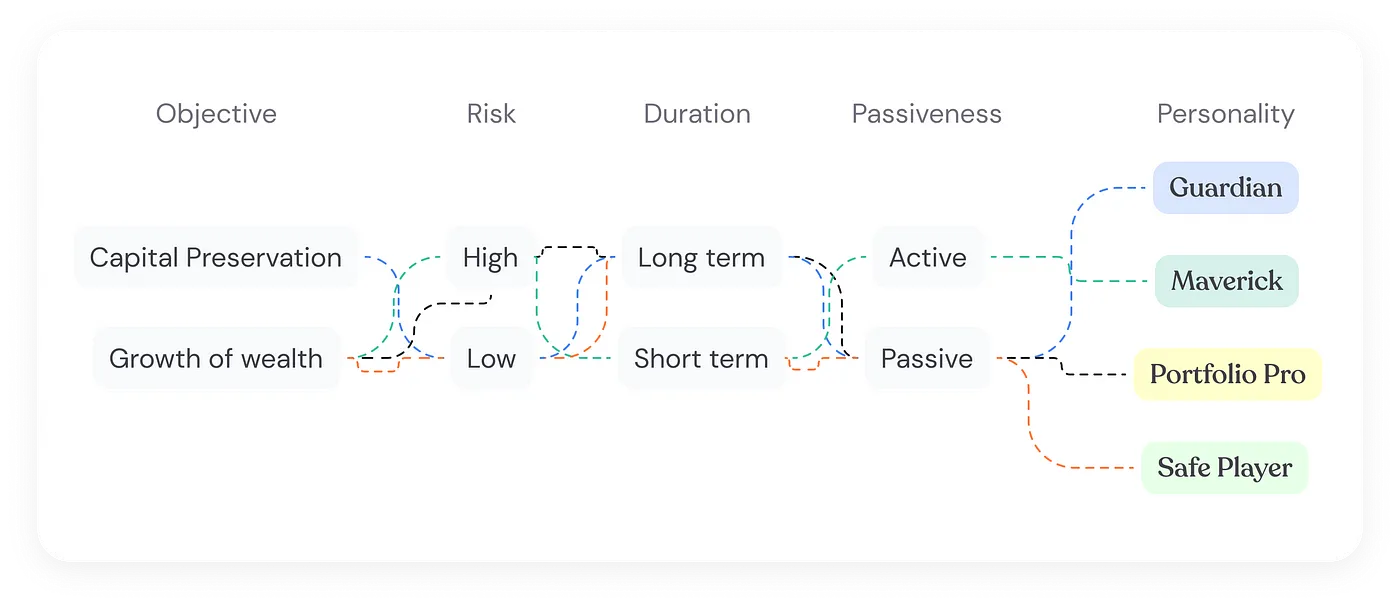
Cracking the Code: Unveiling the Logic Behind Our Results!
Here’s a diagram illustrating various scenarios and their corresponding outcomes.
A flow explaining the possible results for different answers
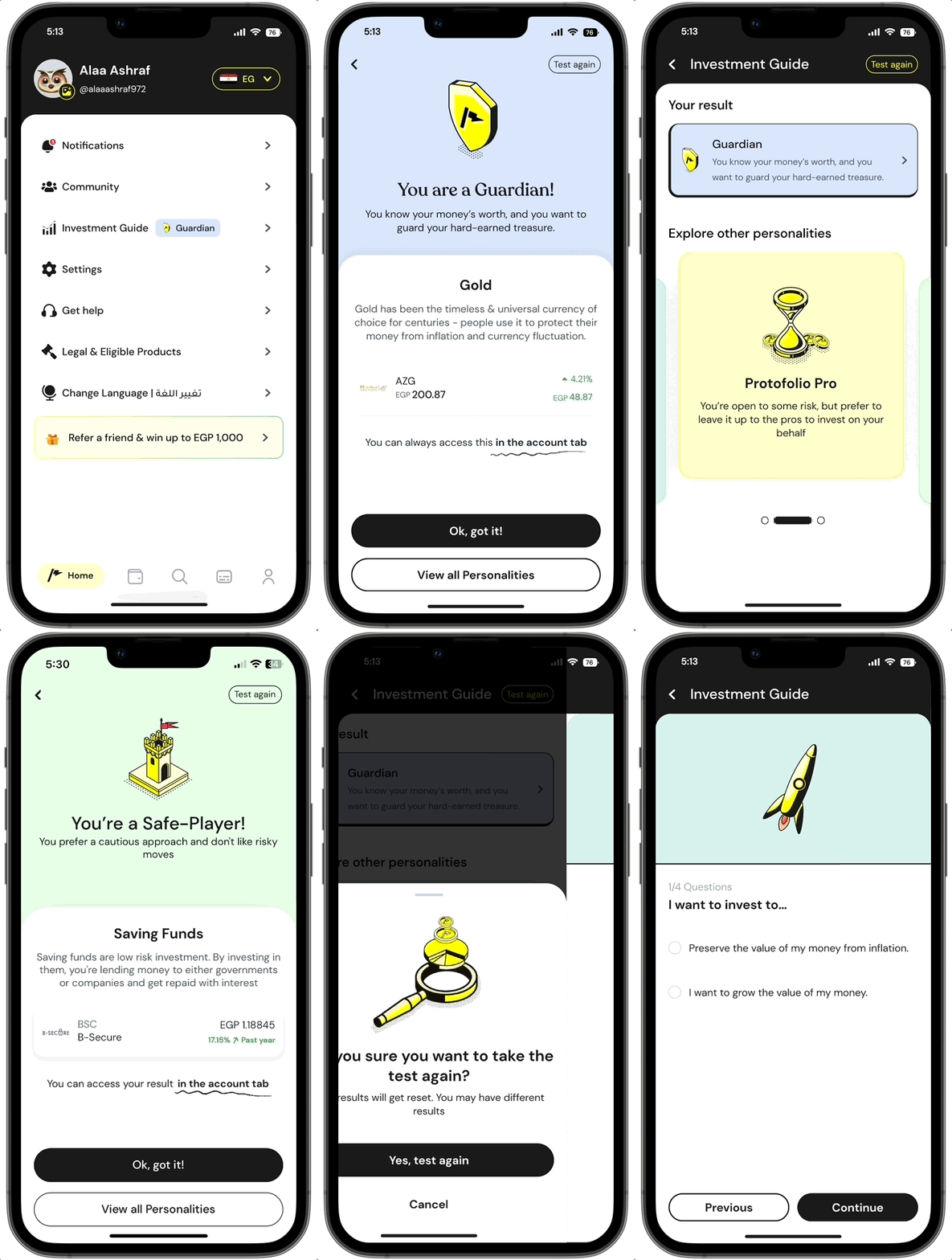
Are you curious about exploring different personalities? — we’ve got you covered
We provided a flow where you can view all personalities after you finish the guide. Browsing through other personalities and learning about them might motivate investors to explore more opportunities. We also allowed the users to redo the guide if they wanted to.
We provided a flow where you can view all personalities after you finish the guide. Browsing through other personalities and learning about them might motivate investors to explore more opportunities. We also allowed the users to redo the guide if they wanted to.
Test again and explore all personalities flows
Usability testing sessions for an extra layer of confidence
We tested with 5 users to understand their behaviors and to make sure the flow was clear and easy to digest.

Usability testing sessions highlights
The Moment of Truth: Examining how well this feature has delivered
An increase of ≈ 8p.p in the conversion of funded accounts after releasing this feature.

Data after releasing the feature
In conclusion, introducing the Investment Guide on Thndr App has proven to be a pivotal step towards enhancing the user experience and encouraging informed investment decisions. Recognizing the overwhelming nature of starting an investment journey, the Investment Guide assists both beginners and experienced investors in discovering their investor personality and aligning their choices with financial goals and risk tolerance.
And… That’s a wrap!
I hope you found this case study useful and informative. Feel free to contact us on any social media platform if you have any questions. We would be more than happy to have a chat with you.
Have you ever wondered what it takes to lead a team effectively, regardless of the industry? Whether it’s on the battlefield, in a factory, or even on a sports field, the skill of managing people remains essential. You would hear some eye-opening stories from a variety of industries that could inspire you to be a better manager in your day-to-day work.
I’ve always been fond of the term “losing the locker room”, a term that is almost exclusively used in sports but, in my opinion, can teach us valuable lessons. In the context of sports, when people start to say “this coach has lost the locker room”,
it refers to a situation where the team’s coach or manager has lost the support, respect, and trust of the players in the dressing room. This often happens when there is a breakdown in communication, a lack of alignment between the coach’s strategies and the players’ beliefs,
or when the team’s performance and results have been consistently poor and happiness becomes hard to find on the faces of the team.

One of the training sessions led by Carlo Ancelotti at Bayern Munich in 2016 — Source
This even happens at the best of their game
Carlo Ancelotti, one of the most decorated coaches the sport of football has ever seen, was dismissed from his position as head coach of the coaching staff at the German football club Bayern Munich in 2017. When we looked at the numbers he had during his time there, it seemed like a strange decision,
because having a win percentage of 75% from around 60 matches is a solid number! So what had happened back then that made the club management decided to let him go? The answer was simple and straightforward: he had lost the dressing room!
After a heavy 3–0 defeat against the French giants PSG, it looked like things were not going well for the team or for the 4-time UEFA Champions League winner as a head coach. The post-loss events showed severe friction between the coach and the key players of his team,
who had concerns about his tactical methods and decision-making approaches. Players have simply stopped showing support for their manager. Losing confidence and trust in the coach was the main reason that drove the club to announce that Carlo Ancelotti had been relieved of his duties as the head coach.
How does a manager lose his team’s locker room?
At its core, management is built upon multiple essential pillars, including effective communication, organization, decision-making, delivering results, leading and inspiring team members, holding oneself accountable and responsible, and many other traits. No one would be able to excel in all these pillars,
but maintaining a reasonable level of awareness and focus on them all is a must, and overlooking any of them could have risky consequences as well. This relates to the question of the day: Have you ever asked yourself why even good managers sometimes lose their team’s support? I have! So let’s look at some of the most common mistakes they make that lead to this.
Broken Promises and Absence of Transparency
Do you remember that word that your manager gave to your teammate, that he’d get the long-awaited vacation to spend with family once we delivered that important milestone that we had committed to with the customer?
Unfortunately, change requests kept coming, and for a whole three months until now, this promise hasn’t been fulfilled, and everyone can see how the morale and performance of that teammate have been declining day after day. Not only that, but everyone in the team now starts to take your manager’s words with a pinch of salt because, most probably, he won’t keep them.
Also, sometimes, for managers to avoid making any promises, they show little or no transparency with the team in regards to their plans, expectations, and what should be done and what shouldn’t, and this can lead to misunderstandings, mistrust,
and a sense of exclusion among team members. It prevents productive collaboration and keeps the manager as the sole owner of the decision-making process, meaning that everyone else is only required to comply with his or her orders.
Lack of Support and recognition
There are various ways to provide support to the team, including acknowledging and commending their successful efforts, offering both positive and negative feedback that can be transformed into actionable steps, and granting empowerment while guiding them,
particularly during conflicts and interactions with external parties. Taking joint responsibility in the event of unfavorable outcomes, rather than leaving them to face the consequences of a wrong decision, is crucial. Managers who do not have these as core responsibilities and a high priority will often miss many opportunities to get full support from their teams and unleash their potential.
Also, lack of recognition, keeping people in the dark, and taking the team credit are some of the main reasons to question the manager’s credibility and integrity, giving the team all the reasons to stop supporting their leadership.
Unrealistic asks and changes that drain everyone
We’ve all had a manager who wants everything done all at once and perfectly like everything has a high-priority label on it. Aside from the usual requests to get things done, it’s not easy for teams to adjust to new plans or different ways of doing things,
especially when they’ve been doing them the same way for a long time. Some managers initiate significant changes without thinking about how much the team can handle,
how they feel, or whether they have the right skills. They do this to make their bosses happy or to show they’re doing a good job. Even if these changes work or don’t work, the team doesn’t feel like they’re part of it and won’t be very motivated to make things work better.
Failure to address and tackle problems
There is a reason why people choose to become managers. They ought to be good listeners who allow everyone the opportunity to speak their minds and discuss their issues, worries, and concerns. However, just listening well was not enough because managers are there with the power to take action and improve their people’s lives.
The team will begin to wonder if their manager is truly taking their notes seriously and even working on solving them, making them feel ignored and undervalued in the team. Let alone that some managers have a tendency to downplay their team’s problems and question their worth.
A lack of empathy could also give the team the impression that their feelings are invalid. Failure to follow up on issues and deflect them due to outside factors is an act of a weak management style that doesn’t help its holder take his team forward. It’s important for any manager to avoid being a passive communicator in situations that require assertion or active communication because passiveness and avoidance quickly erode a manager’s credibility.
Favoritism
Favoritism involves treating certain individuals or groups more favorably than others. This can happen based on various factors such as personal relationships, gender, performance, shared beliefs, or social relevance. Within teams, favoritism becomes apparent when a manager provides special treatment to a specific team member,
perhaps due to recent accomplishments, resulting in a lower standard of accountability for their mistakes compared to others. This unequal treatment creates a lot of tension within the team and makes people feel angry and uncertain,
which disrupts team unity and cohesion while also raising doubts about the manager’s overall fairness, particularly in performance evaluations and compensation decisions.
What are the consequences of losing the locker room?
When a manager loses the trust and confidence of their team members, it doesn’t necessarily indicate immediate underperformance or the manager being fired for that particular reason. However, it can lead to major problems such as a toxic culture, demotivated team members, missed opportunities, and a slower pace.
One consequence of losing the locker room is having a team that mostly consists of followers, not leaders. Team members who once took initiative may become shy and less willing to openly share their thoughts and ideas or take responsibility. This can hinder the team’s momentum and pace,
leading to decreased efficiency and effectiveness in achieving goals. Additionally, a team that has lost trust in its manager often requires higher maintenance efforts. Managers may need to invest more time and energy into addressing conflicts, managing unhappy or frustrated team members, and even micromanaging the whole team!
This lack of trust can also contribute to high turnover rates, as team members who feel unsupported or undervalued are more likely to seek opportunities elsewhere. This turnover disrupts team stability and growth. Resistance to change becomes a frequent matter because the team knows what would happen if things went south.
Lastly, when unfortunate events occur, a team that has lost trust in its manager is less likely to support and exert extra time and effort to help the manager get things back on track.
Final Thoughts
No matter how great a manager you are or how amazing your skills are, you will go nowhere without a team that trusts and supports you through thick and thin. I’ve seen many amazing managers fall into that trap of losing their teams’ locker rooms because of a series of wrong decisions or bad assessments of the situation. Having happy stakeholders is great;
committing to deadlines and delivering high-quality results is amazing; but nothing would beat a high-performing, motivated, and happy team on any given day.
This article was written by Muhammad Hani, Thndr’s Head of Engineering, who is passionate about building products that matter.
Pick your poison…
 Mustard Skittles |
 Tomato Blood Ketchup |
Two condiments, two limited edition holiday products. One of them works, the other is vomit-inducing (hint: it’s not the blood-themed ketchup).
So what went wrong here? Both ideas are clearly ‘outside the box’ – the highest honor that can be bestowed upon a marketing professional. Why does one work and the other flop? Before we can talk about thinking and boxes and thinking outside of boxes, let’s set a few things straight. First order of business…
What is a box?
It’s easy to picture a small and stuffy cardboard box as a metaphor for restricting your thoughts and creativity. But this isn’t how the famous saying came about. Thinking outside the box refers to a very literal 3×3 grid of dots.
The grid made one of its earliest appearances in “Sam Loyd’s Cyclopedia of 5000 Puzzles, Tricks, and Conundrums” published in 1914.
The grid came with a simple challenge: Without lifting your pen from the paper, connect all the dots with as few lines as possible.

You can give the puzzle a go yourself and then check the solution linked here to see how well you did.
What is thinking?
Now that we’ve got the box covered, let’s move on to thinking. “Thinking outside the box” usually refers to creative thinking. To keep things simple here, let’s say that thinking is the act of creating new thoughts out of old ones.
What is thinking outside the box?
As elegantly illustrated with the 9 dots puzzle – thinking outside the box means breaking free of the arbitrary limits you’ve unconsciously set for yourself. This is also known as lateral thinking – a term popularized by psychologist Edward De Bono.
When thinking outside the box goes wrong
Once upon a time in the distant year of 1950, you could count the number of TV channels on one hand. Brands had an audience of millions to advertise to, and most importantly, they had their attention. Today, things look a little bit different. In the time that it took you to read this far into the article, over 500 hours of video were uploaded to YouTube.
Toss in another half dozen social media and streaming platforms and a high-speed connection to the cumulative knowledge of the human race in its entirety and you’ve got yourself an attention economy. More brands than ever are scrambling for the leftover scraps of attention nestled in between an Instagram post of your coworker’s wedding party and a video of a singing cat.
Here’s the secret sauce though: creativity captures attention. The desperate attempt to stand out in a hopelessly overcrowded market has led to an arms race of creativity that would give the scientists of the Cold War a run for their money. Thinking outside the box has become so valued that we’ve started going…
from this… |
to this. |
Creativity for the sake of creativity, is far removed from goals or purpose. The original 9-dot puzzle encouraged you to think outside the box to find a better, more efficient solution. It wasn’t about tossing the rules in the trash.
Mustard Skittles: A limited edition product created by the French for National Mustard Day. The brand went all out with a beautifully themed car and was reported on by several magazines. Is it out of the box? For sure. But what objective does it fulfill?
It captured attention… but then what? The flavor was universally hated and the partnership between the two brands adds no apparent value to either. The idea is ‘wild and crazy’ for the sake of being wild and crazy. You may as well duct tape a banana to a wall.
Tomato blood ketchup: A limited edition product created by Heinz for Halloween. Ketchup is a fun and playful condiment. A sweet unnaturally red goop that stands out in aisles of cream and brown. You can drizzle it all over your fries and burgers. Kids love ketchup. They like to play with it. So why not lean into the essence of ketchup? With a simple package redesign, an ordinary dinner is transformed into a gory ghoul feast.
Thinking inside the box
Tomato blood ketchup takes a product’s essence and boosts it unconventionally. Instead of following a linear path of thinking “What monster should we put on the packaging? What if we create an ad where vampires love ketchup?” Heinz broke free of regular thinking patterns – thinking outside the box – and temporarily renamed their hero product. Mustard Skittles on the other hand are a shallow cry for attention.
So when it comes to being creative – it sometimes pays to “think inside the box” a little. Get close and comfortable with the core of your brand, its unique selling points, and what makes it tick. Always keep your goals and objectives in mind.
Red Bull used to fill trash cans with empty cans to create the illusion that everyone was drinking it – an out-of-the-box execution of a very inside-the-box proposition (See: 9 out of 10 dentists recommend our toothpaste). Texas’s award-winning littering campaign “Don’t mess with Texas” started with them taking a step back to redefine their audience – the most basic of marketing exercises.
When they discovered that their audience was pickup-truck riding, beer-drinking, and gun-loving teens, thinking outside the box was easy. They pivoted from a tree-hugging angle to a “don’t mess with us” attitude.
Closer to home
Ramadan is ad season in the MENA region. The cost of running ads spikes as consumer attention plummets in an overcrowded space. So how could Thndr stand out?
Getting started with investing, as seamless as Thndr makes it, can take a bit of a learning curve – and having a close friend or family member introduce you can make getting started much easier. That’s why word of mouth can be a particularly effective channel for growth.
An insight we noticed is that during Ramadan, people meet with family and friends almost daily for iftar – the perfect opportunity for spreading through word of mouth. So instead of running ads, we took our referral bonus and doubled it for the entire month of Ramadan. We thought outside the box by first thinking inside the box.
This article was written by Danny Arafa – our in-house creative. From children’s books to food magazines, social media content, and now fintech – Danny loves testing the bounds of creativity with a business-oriented approach.
Imagine your career is a game you play. The work you perform are monsters to slay. Every time you beat a beast (solve a problem), you gain experience and level up. The fiends you vanquish create value that you can keep or exchange with others, allowing you to earn money, create impact, and ultimately keep playing.
My adventure started when I was looking for quests (jobs) to fight monsters for gold and glory. But the quests available for me offered neither. My skills weren’t too bad, as a student, I regularly fought practice monsters on my own in lessons and online tutorials. But those didn’t create value that I could exchange for gold, and nobody was willing to trust an unestablished nobody like me with their quests.
I was my first client, creating quests to build up my skills. But it wasn’t until I started fighting monsters for other people like friends, open source projects, or groups at university, that the impact of the value I created, defeating their monsters, earned me enough fame to become a software developer and unlock my first job class  .
.
To advance my class, I needed companies to fund and issue quests for me. I thought about joining a pre-seed startup. Like a small outpost camp in the middle of an untamed jungle. The dungeons (problem domains) startups extract customer value from, hold a rich sprawling ecosystem of monsters to kill. Dungeons with untapped potential, that can raise you from nomad to king as the startup grows. Joining a global corporate on the other hand could offer a safe measured start. Like an empire spanning large tamed continents, I would be a cell in a titan fighting a war with colossal beasts, and as I grow through well-charted paths, I would prepare the skills, fame, and wisdom I would need to one day answer the tempting call for adventure, should I outgrow the position I hold.
With every monster my company vanquished, we unlocked deeper levels in our dungeons, summoning new kinds of fiends. But with every level conquered, the high-level quests that my senior employees could use to advance, become scarce. It becomes my job as a manager to find the right quests for the team to develop. But even as the owner of a software house, I reached a bottleneck as I outgrew my own company. So when an offer came, from a rising kingdom on a mission to chart the road to financial freedom, I answered the call.
The old financial services guard built a cryptic maze for wealth that only they can pass. Littering the wealth dungeon with poverty traps for those that dare to seek its treasure without their guidance. Thndr is building a safe way for everyone to growth their wealth like the wealthy. Overcoming the leviathan of access to simple ways of saving and investing for everyday people.
Wether you’re an Engineer searching for monsters to slay or a Manager that guides their way. We have herculean tasks across the MENA region, unlocking compatible investment opportunities, creating a social community for financial wellness, educating and empowering the masses, and the system infrastructure that can manage all of that. We need your help building a new way, for safe passage through the wealth dungeon.
Oh noble hero, your journey awaits. Will you answer the call to join our adventure?
Article written by Amr Draz – self proclaimed “seeker of wisdom in complex systems” and director of engineering at Thndr.